The easiest decision can appear to be: Don't buy it.
Zero dollars spent.
Except zero is not the real number.
Students still need to learn. Teachers still need to teach. Experiences still need to be delivered. Staff still need to prepare lessons, supervise activities, troubleshoot technology, move students through limited resources, organize spaces, and repeat the process for the next class.
Those costs already exist. They are simply harder to see.
The 15-minute question
Our Cost Calculator starts with a deliberately simple question:
What does it cost to give one student 15 minutes of learning?
- Not what does the headset cost.
- Not what does the license cost.
- What does the actual learning engagement cost?
That changes the calculation considerably.
With Sensible-VR, under an ideal high-utilization scenario over five years, the technology cost can fall to approximately:
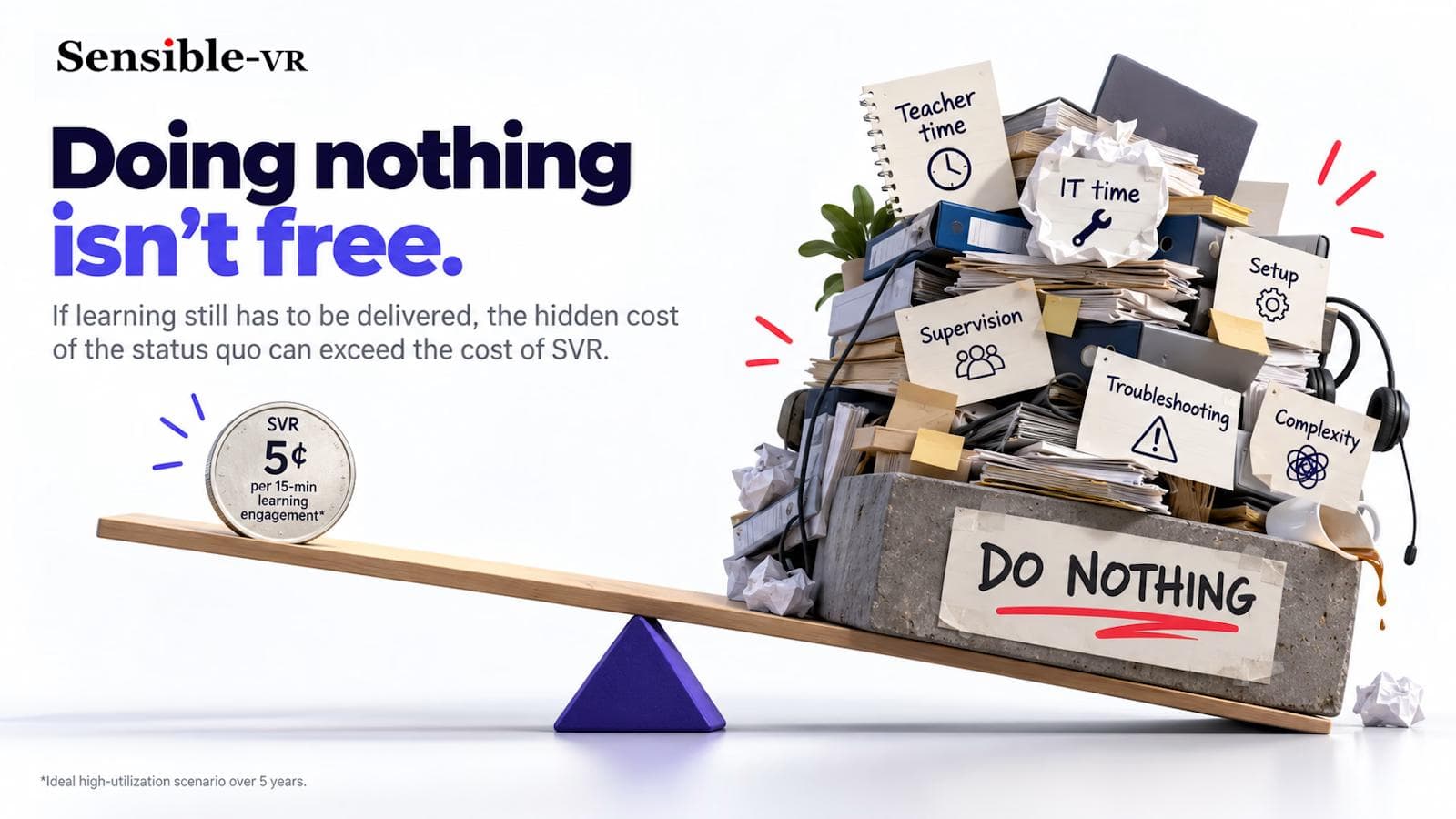
US$0.05 per student engagement.
Five cents.
Let that sink in for a moment. It’s not interesting simply because five cents is inexpensive. It becomes interesting because it gives us something against which to compare the alternative.
What happens if you don't spend the five cents?
The learning requirement does not disappear.
Someone still has to deliver it.
If an alternative system requires a teacher or facilitator to spend additional time setting up equipment, monitoring students, solving connectivity problems, managing accounts, preparing content, supervising movement or resetting devices between users, that labour has a cost, even when nobody sends the school an invoice for it.
- A teacher's time is not free because it was hidden inside a salary.
- An IT technician's time is not free because it was absorbed by the department.
- A classroom being occupied for setup or specialized use is not free even though the school already owns the room.
- And the enthusiastic teacher who stays late to make everything work is certainly not free simply because nobody bothered to calculate the value of those hours.
These are real economic costs.
Five cents versus a few minutes
This is where this idea becomes surprisingly powerful.
If SVR can provide a student learning engagement for approximately five cents in overall cost, an alternative does not need to be particularly inefficient before not buying SVR costs more than buying it.
Consider teacher time.
At US$100 per hour, one minute of teacher time costs about $1.67.
That means five cents represents roughly 1.8 seconds of teacher time.
- Not two minutes.
- Not twenty seconds.
- Less than two seconds.
If using another delivery method adds even a tiny amount of recurring teacher workload per student, its incremental labour cost can already exceed the amortized technology cost of the SVR engagement.
And that is before counting IT support, device management, network administration, charging, troubleshooting, room preparation, supervision or other operating costs.
This is the distinction procurement often misses
The choice is not:
Buy SVR: $X
Do nothing: $0
The real comparison is closer to:
Buy SVR + operate it
versus
Continue paying for the existing way of delivering the same learning outcome.
Once the second number is calculated properly, doing nothing may be surprisingly expensive.
This is why I describe SVR as having accretive value.
The system is not simply another technology purchase that needs to justify its existence.
At sufficient utilization, every additional use spreads the fixed investment across more learners, while the marginal cost of another engagement becomes extremely small.
The asset keeps producing educational value. Five cents at a time.
There is also an opportunity cost
The calculation becomes even more significant when we consider what teachers could be doing instead.
- Every minute spent acting as a VR technician is a minute not spent teaching.
- Every minute spent provisioning accounts is a minute not spent with a struggling student.
- Every unnecessary supervision requirement consumes professional time that could have been used for something schools actually hired educators to do.
That is an opportunity cost, even if it never appears as a line item in the school budget.
Technology should remove those costs wherever possible, not quietly transfer them onto teachers.
A deliberately provocative conclusion
So, I am comfortable making what initially sounds like a rather bold claim:
For a school that will actually use it, it can cost more not to buy Sensible-VR than to buy it.
That does not mean every school should purchase VR, nor does it mean every implementation will achieve an ideal five-cent engagement cost.
- Utilization matters.
- The five-year lifespan matters.
- The number of students matters.
And assumptions should always be challenged. But the comparison must be honest.
You cannot put every visible cost of a new system on one side of the ledger while placing zero beside the status quo.
- The status quo has a cost.
- Teacher time has a cost.
- IT time has a cost.
- Supervision has a cost.
- Complexity has a cost.
- And lost teaching time has a cost.
Doing nothing is not free.
Sometimes, it is the most expensive option of all.