
Mrs. Applebaum wants her learners to have the benefit of immersive learning. She can see the value of taking students somewhere they could never otherwise go: inside a cell, through a historic city, beneath the ocean, into a workplace, or into another person’s perspective.
But she has also lived through decades of educational technology promises.
She saw calculators arrive, followed by overhead projectors, video players, computer labs, interactive whiteboards, laptops, tablets, learning-management systems, coding initiatives, 3D printers, robotics labs, and more. Some were useful. Some were genuinely transformative. Some quietly disappeared after the funding, enthusiasm, or technical support disappeared.
Mrs. Applebaum is not against technology.
She is against being told that it is simple when it is not.
The problem with “just”
Over the years, Mrs. Applebaum has heard one word more than almost any other:
Just.

- Just connect everything to the Wi-Fi.
- Just download the app.
- Just create the student accounts.
- Just update the devices.
- Just reconfigure the firewall.
- Just ask IT to whitelist the website.
- Just join this Saturday morning professional-development session.
- Just spend Sunday evening working out how it fits into Monday’s lesson.
- Just learn the new dashboard.
- Just monitor the students while they use it.
- Just reset it if something goes wrong.
- Just find another app when the old one is no longer supported.
None of these requests is necessarily unreasonable on its own. But schools do not experience them one at a time.
They accumulate.
They land on teachers who are already planning lessons, assessing work, speaking with parents, supporting individual learners, attending meetings, managing behaviour, covering absent colleagues, and trying to leave enough energy for their own lives.
The word just can become surprisingly harsh. It dismisses the time, expertise, patience, and invisible labour required to make a new tool work in a real classroom.
That is what Mrs. Applebaum notices.
A tale of two teachers
I first began talking about Mrs. Applebaum in 2019. She later appeared in an article called The Tale of Two Teachers, alongside Josh: a young, energetic teacher fresh from university.
Josh is enthusiastic about new technology. He enjoys experimenting, troubleshooting, sharing ideas online, and spending extra time making something exciting work. Every school has a few Joshes. They are often the champions who introduce colleagues to a new possibility.
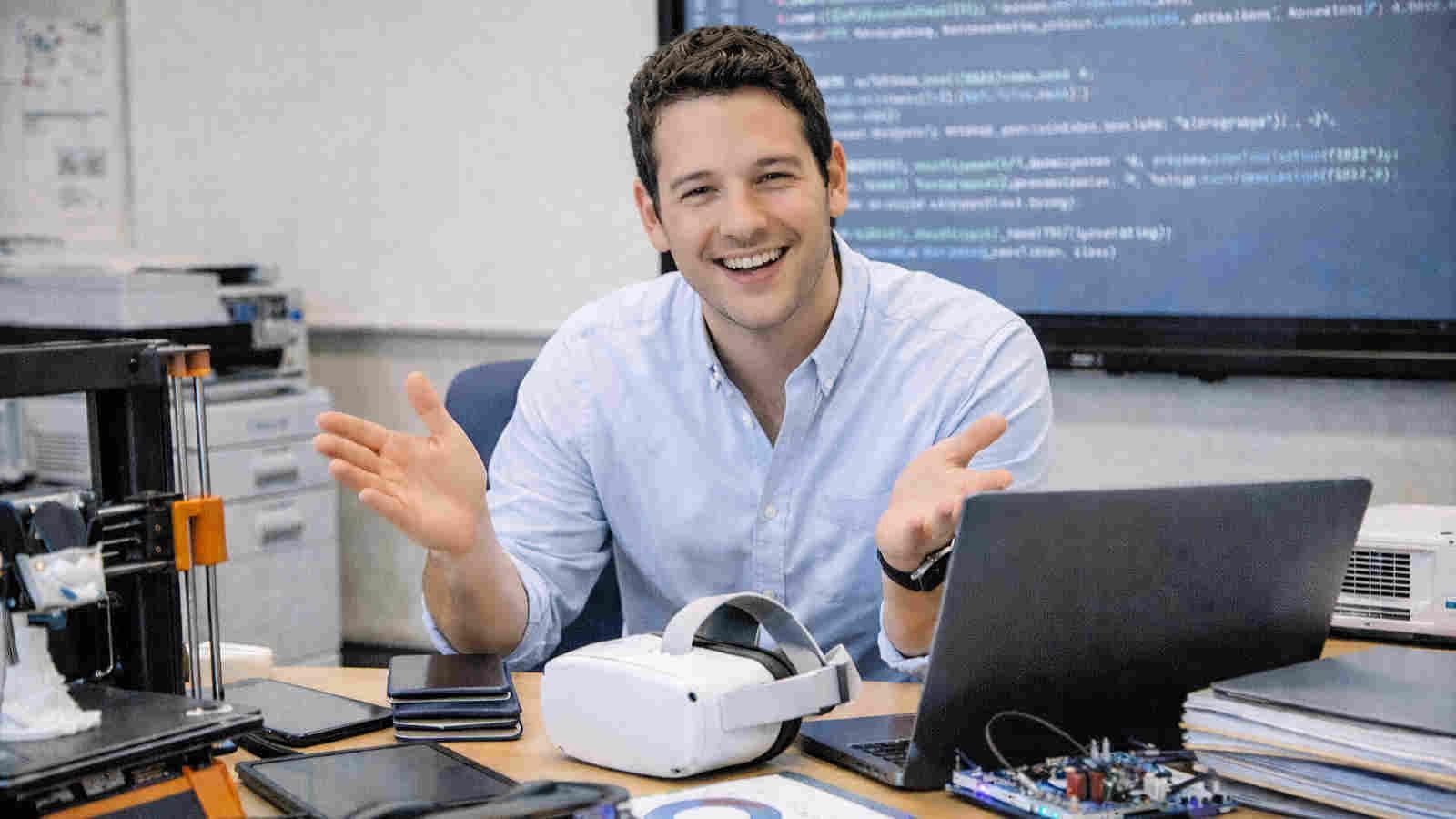
Schools need Josh.
But they also have many more Mrs. Applebaums.
The danger begins when a technology solution is designed only for Josh.
Josh may be willing to spend hours exploring a new headset, setting up accounts, solving Wi-Fi issues, testing apps, and creating a workaround when something does not behave as promised. He may happily become the unofficial specialist—the person everyone calls when the devices need fixing.
That generosity is valuable. But it is not a scalable model.
A solution that works only because one passionate champion is willing to carry its hidden burdens is not yet a solution for a school. It is a hobby with a champion attached.
And when Josh changes schools, becomes a department head, goes on leave, or simply burns out from being the person who always makes everything work, the program often follows him into a cupboard.
Mrs. Applebaum is the real test
Mrs. Applebaum should not be treated as the obstacle to innovation. She is the test of whether innovation is ready.
- Can she take the device, put it in a student’s hands, and trust that it will do what it is meant to do?
- Can students use it without being pulled into social media, games, account prompts, updates, or unfamiliar menus?
- Can she focus on teaching rather than device management?
- Can the technology work reliably in a school with imperfect Wi-Fi—or no Wi-Fi at all?
- Can it protect student privacy without asking a teacher to become a data-policy expert?
- Can it remain useful for years, rather than becoming obsolete when a consumer platform changes direction?
- Can it be used safely, calmly, and repeatedly without requiring a facilitator to hover over every learner?
If the answer is no, then the problem is not Mrs. Applebaum’s willingness to learn. The problem is the design of the system.
Respect is a design principle
Respecting Mrs. Applebaum means designing immersive learning around the conditions teachers actually face.
- It means reducing steps rather than adding them.
- It means avoiding unnecessary accounts, social-media-connected platforms, constant internet dependence, and complicated management layers.
- It means offering content that is ready to use, easy to find, appropriate for learners, and connected to what schools are trying to teach.
- It means recognizing that teacher time is not free simply because it does not appear on a hardware quote.
- It means building for the ordinary Tuesday afternoon—not only for the demonstration day, the pilot project, or the technology conference.
The goal should not be to turn every teacher into a VR specialist.
The goal should be to give every teacher another dependable resource in their toolkit.
Build for the many
Mrs. Applebaum is fictional, but she is based on people I know: experienced, hardworking, sincere educators who have given decades of their lives to students. She represents the teachers found in schools everywhere—the ones who quietly make learning happen every day.
They are not asking for less innovation. They are asking for innovation that respects them.
If immersive learning is to reach every school, it cannot depend on a small number of enthusiastic champions doing unpaid technical labour behind the scenes. It has to work for the many regular teachers who are willing to use a good tool when it is genuinely ready for them.
Build for Mrs. Applebaum, and Josh will still love it.
More importantly, Mrs. Applebaum will gladly use it—because it helps her do what she has always wanted to do: empower and engage her learners.
That is how immersive learning becomes scalable.
Respect Mrs. Applebaum.