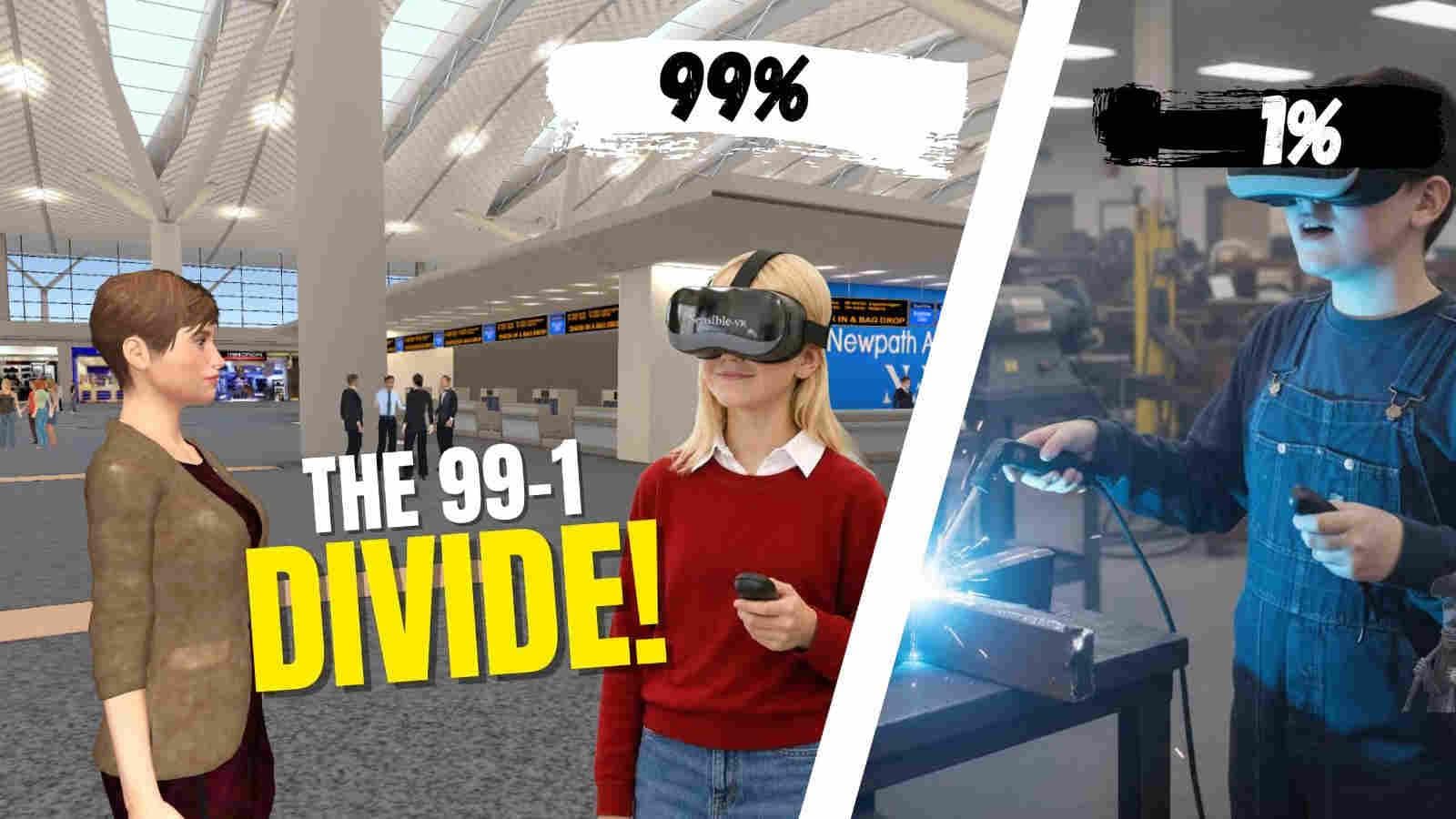
The figure began as a way of testing a much simpler question:
How much of what people actually learn to do depends fundamentally on precise physical movement being tracked?
Starting with the workforce
We used the U.S. Bureau of Labor Statistics 2024 National Employment Matrix as a large, independent dataset.
The BLS counted approximately 169.96 million jobs across the U.S. economy in 2024.
We then identified a deliberately narrow group of occupations where precise hand position, movement, trajectory, steadiness or timing is central to performing the job, and where 6 DoF training can therefore make an especially compelling case.
Examples included:
Welding. Surgery. Dentistry. Dental hygiene. Jewelry-making. Dental laboratory work. Precision painting and coating. Watch and clock repair.
These are jobs in which how the hands move may itself be part of what needs to be learned. BLS descriptions reinforce that distinction. For example, welders use hand-held equipment and require a steady hand, while jewelers shape, solder, repair and set materials using precision tools.
Using that strict definition, the selected occupations represented approximately 987,400 jobs.
The calculation was straightforward:
987,400 ÷ 169,956,100 = 0.58%
Rounded, that is approximately:
0.6%
Which leaves:
99.4%
That was the origin of our 99:1 shorthand.
It is a proxy, not a curriculum statistic
This distinction is important. We are not claiming that precisely 0.6% of education requires 6 DoF.
The 0.6% comes from a workforce analysis. It provides a useful way of asking how common occupations are in which precise physical manipulation is fundamental to the work itself.
In fact, it may overstate the amount of learning that requires such tracking.
Consider a welder.
Learning welding includes actual torch manipulation, and that is an excellent use case for 6 DoF. But welding education also includes metallurgy, safety procedures, reading drawings, equipment knowledge, defect recognition, mathematics and theory.
A surgeon must develop extraordinary psychomotor skills. But medical education also includes anatomy, physiology, diagnosis, pharmacology, clinical reasoning and countless other areas where measuring the precise trajectory of the learner's hands is unnecessary.
Even within the occupations where physical movement matters most, not all of the learning is psychomotor learning.
That is why we stopped treating 99.4/0.6 as though it were a precise educational ratio and adopted the simpler 99:1 principle.
The point is not that 6 DoF is unnecessary
Quite the opposite. When the learning objective is:
Move this hand, holding this tool, through this space, in this way...
6 DoF can be exactly the right technology.
Welding, surgical procedures, dentistry and other psychomotor skills are obvious examples.
But when the objective is:
Understand this. Observe this. Explore this. Identify this. Decide this. Remember this. Experience this.
… precise physical tracking may contribute very little to the learning objective.
And that matters because additional capability is not free.
It can mean additional hardware cost, space requirements, setup, supervision, processing and potentially the generation of much richer behavioural data.
Start with the learning objective
So 99:1 should not be interpreted as:
“6 DoF is only useful 1% of the time.”
A better interpretation is:
Before requiring 6 DoF, ask whether precise physical movement is actually part of what the learner needs to learn.
If it is, use the right tool.
If it isn't, additional tracking should not automatically be considered better simply because it is technologically possible.
More capability is only better when the learning requires the capability.
That is what 99:1 means.
Source and methodology
The calculation uses the U.S. Bureau of Labor Statistics 2024 National Employment Matrix, which reported approximately 169.96 million jobs in 2024. A deliberately restrictive group of occupations in which fine physical manipulation is intrinsic to job performance totaled approximately 987,400 positions, or 0.58% of total employment.
The occupational selection is Sensible-VR's analytical categorization, not a BLS classification of “6 DoF jobs.” The resulting 99.4/0.6 split should therefore be understood as a workforce-based proxy used to frame the question, not as a measured percentage of educational content.
This is meant only as a starting off place, from which many will have varying opinions. But rather than default to “learning is better when you are tracking movement”, there needs to be a clear understanding that tracking comes with a real cost, and that has to be a part of the equation.
If learning outcomes are not tied to fiscal prudence, the true outcome may be no adoption at all. This would squander terrific learning opportunities which would otherwise have been within reach.